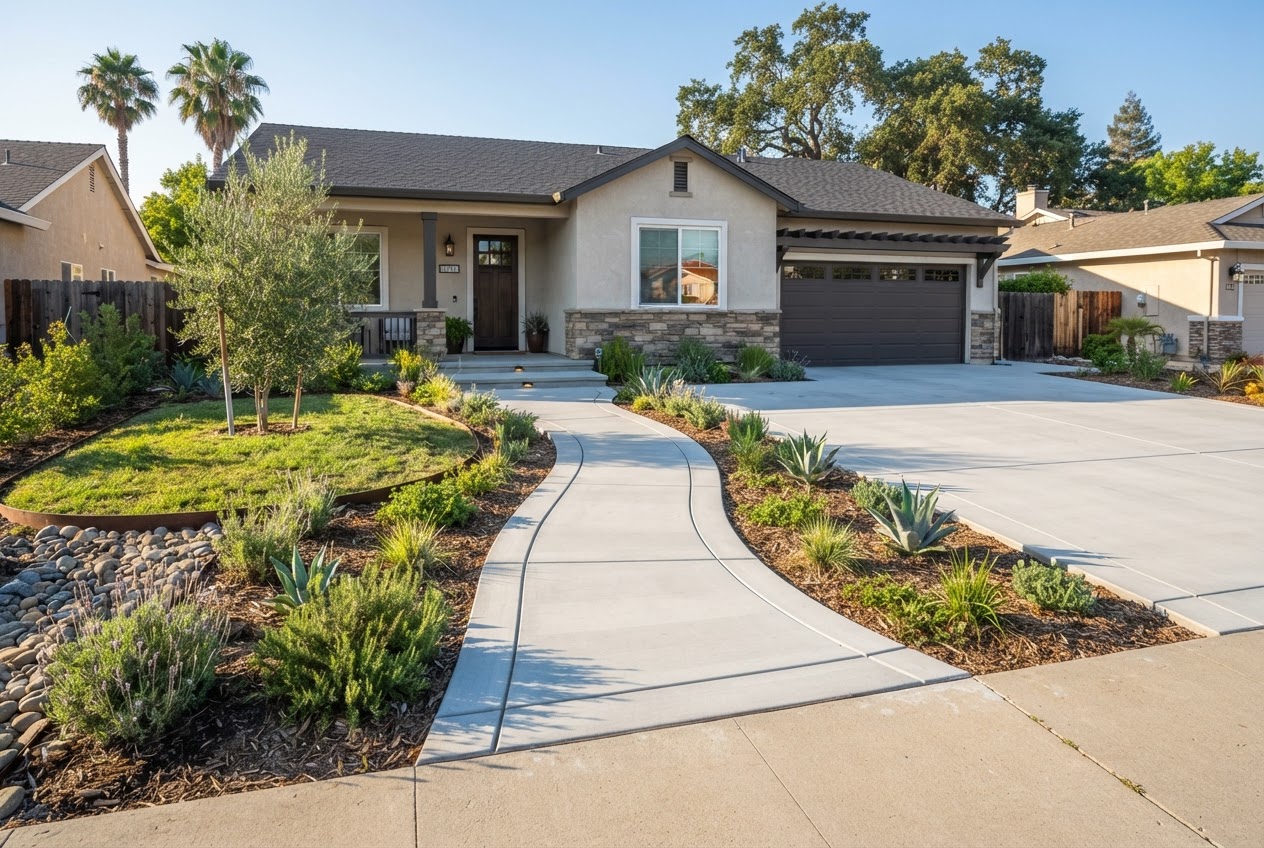
New concrete walkway and RV pad at a Fresno-area home

Walkways · Sidewalks · RV pads

Concrete Walkways, Sidewalks & RV Pads in Fresno, CA

A walkway should make it easier to move around your property without trapping water near your house. A sidewalk should offer a dependable walking surface rather than cracked or lifted panels. And an RV pad needs to support a parked vehicle, not just look like an ordinary patio slab.

Communion Concrete builds new concrete walkways and RV pads and replaces damaged sidewalk sections for homeowners in Fresno, Clovis, Madera and surrounding communities. We plan new pours around the property's actual grades, drainage patterns and intended use, with a written slope-and-drainage plan before installation.

Request a free on-site estimate. We'll review the space, the intended use and the existing surface before outlining the work.

01 · Walkways

Concrete walkways that connect your yard without disrupting drainage

A front path, side-yard walkway or garden path can look simple, but its placement affects more than foot traffic. Concrete changes how water moves over the ground. If a new path blocks the yard's natural runoff, water may gather on one side or travel toward the house instead of away from it.

The route and finished elevation should make sense alongside nearby doors, landscaping, downspouts and existing concrete. That is why our walkway planning includes looking at the lot before deciding where and how to pour.

01

New front walks and garden paths

Communion Concrete takes on new walkways and garden paths. Layout decisions include where people actually need to walk, how the path meets existing concrete, and what happens to runoff during rain or watering. A thoughtful route can make a front entry easier to use day to day and help connect parts of a yard without introducing an avoidable drainage problem. Read about common walkway drainage mistakes.

02

Side-yard paths and transitions

Narrow passages can present practical challenges, including limited access for work and changes in grade between the driveway, gates and backyard. For a path that joins an older slab, the height transition and water direction need to be part of the plan rather than treated as finishing details.

02 · Sidewalks

Concrete sidewalk replacement: individual panels or full sections

A raised edge can become a trip hazard. Cracks, settlement and uneven panels may also indicate movement beneath the concrete. Sometimes a single panel is the problem; in other cases, several adjacent sections need attention.

Communion Concrete replaces both individual damaged sidewalk panels and full sidewalk sections. The appropriate scope depends on what is damaged and what caused it.

Single panel

When one damaged panel may be enough

If the surrounding panels remain serviceable, replacing only the failed section can avoid unnecessary demolition. The replacement still needs to fit the adjacent surfaces, with attention to finished height, joints and how water crosses the area.

Larger section

When more extensive replacement makes sense

Multiple lifted, badly cracked or uneven panels may require a larger replacement area. The visible crack is not always the entire problem. Roots, water and unstable ground can contribute to lifting or settling. A replacement should consider the underlying condition rather than merely cover the damage.

We have encountered large tree roots and saturated subgrade during concrete tear-out work. Those are useful warning signs to consider, but they are not a diagnosis of every damaged sidewalk. The actual cause needs to be assessed at the property. Learn more about our concrete tear-out and replacement work.

03 · RV pads

New and replacement concrete RV pads

An RV pad has a different job from a walkway. It may carry substantial vehicle weight in the same parked position for long periods, with concentrated loads at tires, jacks and support points. A slab suited to a garden path should not automatically be treated as suitable for an RV.

Communion Concrete installs new RV parking pads and can work on sites with an existing pad that needs removal as well as cleared ground ready for a new installation.

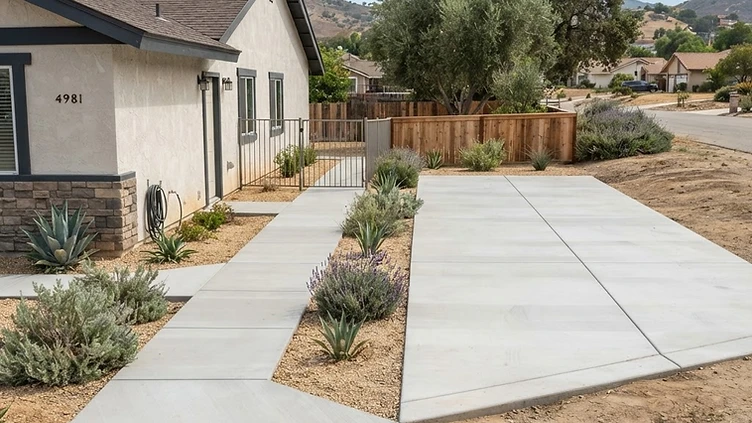
Concrete side walkway and RV pad beside a single-story home

Plan for the vehicle, not just the dimensions

RV pad planning should start with the loaded weight of the largest vehicle expected to use it. That information helps guide the project-specific concrete thickness, reinforcement and approach design. We do not publish a single thickness that would be suitable for every RV, ground condition or use case. Our RV pad planning guide covers what to think about.

When discussing an estimate, it helps to know the vehicle's loaded weight and how you intend to enter, park and leave the space. Those details affect the plan more than square footage alone.

01

Replace an old pad or install on cleared ground

If a pad is cracked, uneven or unsuitable for the vehicle, a new surface may require removal of the existing concrete and assessment of the exposed base. For a new pad on cleared ground, grading, access and water movement still matter. In either case, the scope should address the actual conditions before the concrete is poured.

02

Plan any needed utility crossings early

When an RV pad needs a utility path, sleeves or conduits should be planned before the pour. Electrical or plumbing connections themselves are separate trade work. Any needed crossing should be raised during planning so that the concrete layout and other trades can be coordinated rather than modified after the slab is in place.

The Ground-First Pour

What goes beneath the concrete matters

A finished concrete surface may hide the reason a previous slab moved. Ground that is loose, saturated or unevenly supported can contribute to later settlement or cracking. Proper preparation is therefore part of the decision about a new walkway, sidewalk section or RV pad.

For a walkway, the relationship between the slab and the yard's surface drainage is especially important. For an RV pad, supporting the parked vehicle adds another consideration. The right base and reinforcement depend on the intended use and conditions found on-site; they should not be selected solely from a generic online measurement.

Our Ground-First approach is to examine the property and plan the slope before pouring, with a written slope-and-drainage plan for every new pour.

What to expect when you hire Communion Concrete

  1. Step 1

    Walk and read the site.

    Jose meets you at the property to look at the existing surface, yard grades and intended project area. For an RV pad, the intended vehicle and parking use are relevant to the discussion.

  2. Step 2

    Put the plan in writing.

    For new pours, Communion Concrete provides a written slope-and-drainage plan. The agreed scope can also identify removal or base preparation where those are part of the job.

  3. Step 3

    Prepare and place the concrete.

    Work follows the agreed scope, including the applicable removal, preparation, forming, pouring and finishing activities.

  4. Step 4

    Walk through the result together.

    A final walk-around with the homeowner happens before the work is considered complete.

New projects are commonly booked approximately 2–4 days ahead, but actual start dates depend on the specific project and schedule. This is an availability indication, not a guaranteed start time.

Cost

What affects walkway, sidewalk and RV pad pricing?

A small concrete job is not necessarily priced simply by multiplying square footage. Access, site preparation, removal and disposal of old concrete, drainage corrections and the shape of the pour can all affect the scope.

For sidewalk replacement, the number and condition of the panels matter. For a new walkway, layout and how the path joins existing surfaces can change preparation. For an RV pad, vehicle loads, dimensions, access and any old concrete that must come out are especially important.

Communion Concrete offers a free on-site estimate and describes the job in a written scope. A site visit is the appropriate point to discuss actual pricing rather than relying on a generic price per square foot. See our pricing page for the main cost drivers.

FAQ

Questions homeowners ask

Service area

Concrete suited to Fresno-area properties

Homeowners in Fresno, Clovis and Madera may encounter different soil and drainage conditions from one property to the next. Some yards have compact or slowly draining layers; others behave differently. No single assumption about local soil should replace looking at the actual lot.

The practical goal is the same: make sure new concrete works with the site's grade and use. A walkway should not send runoff toward the foundation, a replacement sidewalk should not ignore the cause of lifting, and an RV pad should be planned for the vehicle expected to use it.

Ready to plan your walkway, sidewalk or RV pad?

If you need a new path, replacement sidewalk panels or a concrete RV parking area in Fresno, Clovis, Madera or a surrounding community, Communion Concrete can review your property and explain the proposed work before the pour. Start with a free on-site estimate and a plan suited to your site's drainage and intended use.

(559) 206-3347 · communionconcrete@outlook.com · By appointment, Friday–Sunday