
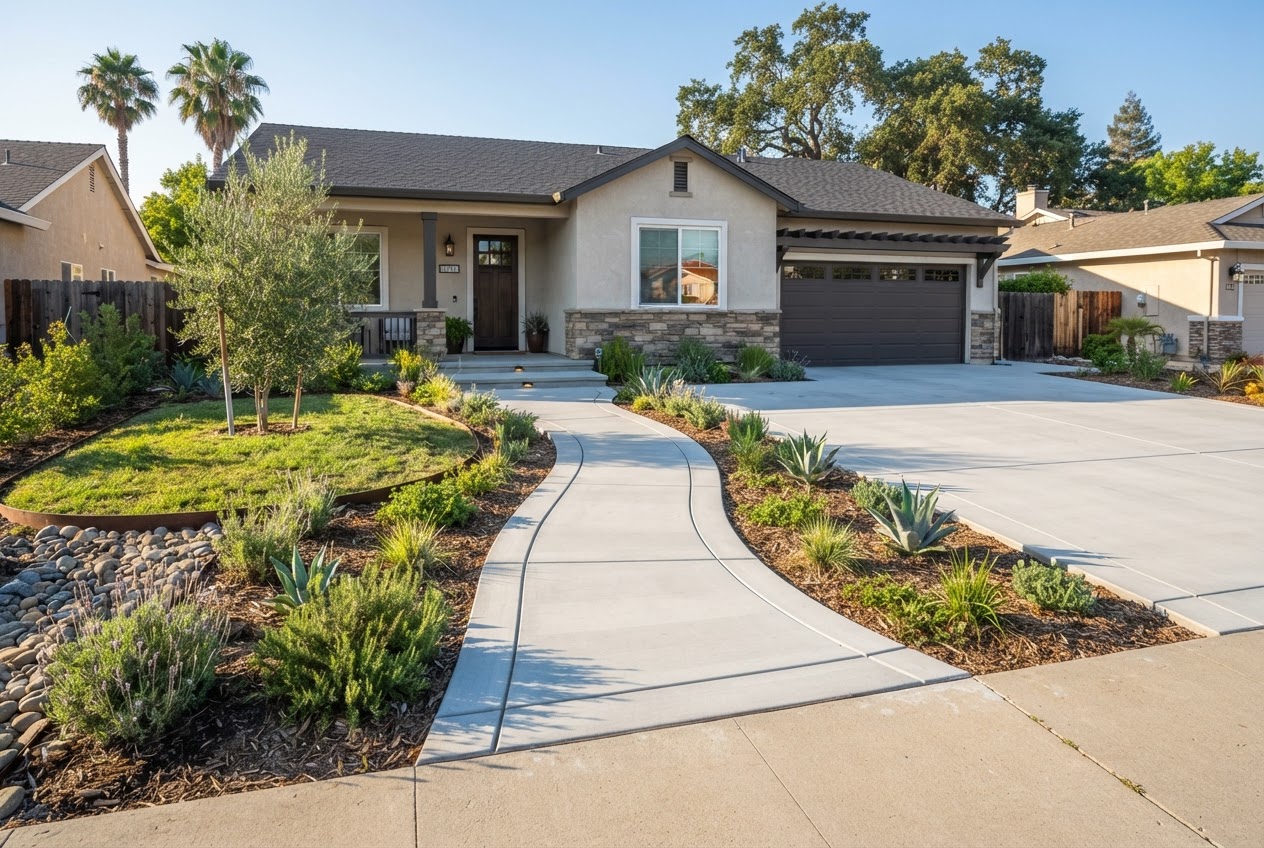
Nobody agonizes over a walkway the way they do over a driveway. It's a small pour, a simple shape, an easy bid. Which is exactly why walkways collect some of the most avoidable drainage mistakes in residential concrete — small slabs get small planning. Here are the mistakes worth avoiding, because a walkway poured wrong doesn't just fail itself; it reroutes water across everything around it.
Mistake 1: Building a dam
A walkway is a long, continuous strip of waterproof material laid across your yard. If the yard's surface water naturally flows across that line — and on much of Fresno's ground it must, since water can't soak down past the hardpan layer a couple feet under the surface — the walkway either lets the water past or blocks it. A walkway poured proud of grade with no thought for the flow path becomes a curb: water backs up on the uphill side, drowns the lawn or planting bed there, and finds its way along the walkway edge — sometimes all the way to the house.
The fix is planned before the pour: set the walkway to work with the yard's flow, not across it — matched to grade where water needs to cross, or with a planned break or pipe under it where the flow is concentrated.
Mistake 2: Pitching toward the house
A walkway that runs alongside the house needs cross-fall away from the foundation. It's a tiny detail — a barely visible tilt — and skipping it turns the walkway into a channel that collects roof runoff and yard water and walks it neatly along your foundation line. This is the single most common small-pour mistake we see on lot walks.
Mistake 3: Ignoring the downspouts
Roof downspouts move a lot of water to very specific points. A walkway routed under or beside a downspout without a plan gives that water two options: pond on the walkway or run under it. Under it is worse — moving water washes fines out of the base, the walkway settles, and joints turn into trip steps. If a slab near a downspout is already stepping, our guide to new concrete vs. resurfacing explains why an overlay won't fix it.
Mistake 4: No fall at all
A dead-level walkway ponds in every low spot its surface has — and every slab has low spots at dead level. The standard is modest fall along or across the path so water keeps moving. Level looking is the goal; level measuring is the mistake.
The takeaway
A walkway is small enough that doing it right costs little extra — the fall, the flow path, and the downspout plan are lines in a scope, not major line items (see what actually drives cost). Our walkways & sidewalks page covers the process, and the drainage FAQ answers what to do about a walkway that's already damming your yard.