
Two driveways, same builder, same concrete, poured the same summer. One is clean a long time later; the other has an offset crack running through three panels. The difference usually isn't the concrete. It's what's underneath — and in Fresno, what's underneath has a name.
San Joaquin soil, in plain language
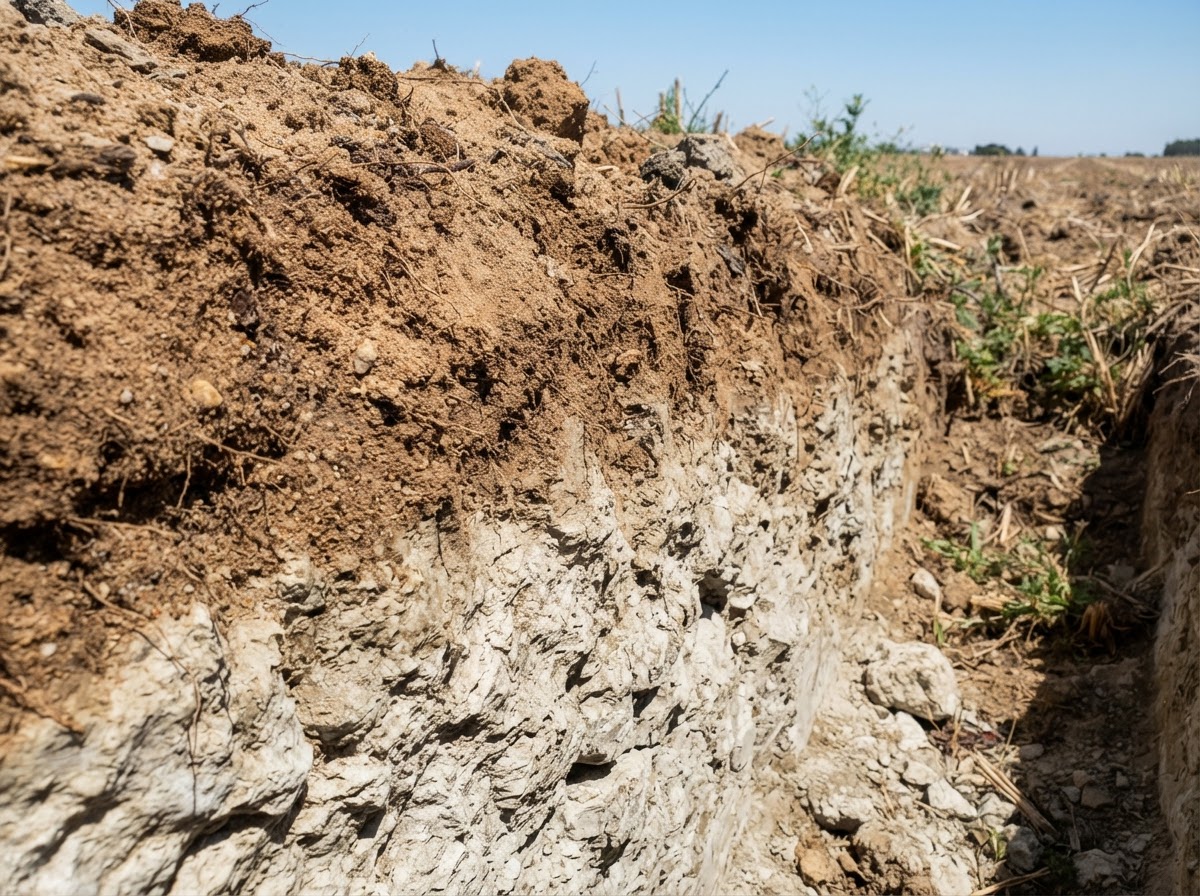
Much of the Fresno–Clovis area sits on San Joaquin soil — it's actually California's official state soil. The profile is simple to picture: a loam or sandy loam surface layer, and then, about two to three feet down, a duripan — a hardpan layer cemented nearly as hard as the concrete above it. Water cannot pass through it.
That one fact drives everything. Rain that lands on this ground can't soak away downward. USDA rates runoff on San Joaquin soils medium to very high — the water has to leave across the surface. And if the surface doesn't carry it away, it sits in the loam layer above the hardpan, right where your slab's base lives.
How that cracks a slab
Concrete doesn't really crack from above — vehicle loads on a properly built slab are handled by thickness and base. It cracks from below, when the base stops supporting it evenly:
- Saturated base. Water perched on the hardpan softens the soil under the slab. Soft spots give under load; the slab bridges the gap until it can't.
- Wash-out. Moving water carries fines out from under slab edges, leaving voids. Corners crack first.
- Wet-dry cycling. Ground that saturates each winter and bakes dry each summer moves — and the slab moves with it, one hairline at a time until a hairline becomes a step.
The part that varies lot to lot
Here's why no template pour works in Fresno: not every lot is San Joaquin soil. Some neighborhoods sit on nearly pure sand that drains almost instantly and never perches water at all. Two streets apart, the right base preparation and the right slope plan can be genuinely different. Reading which ground you have — before pouring — is the entire reason our process starts with a lot walk instead of a quote.
What this means for your project
If you're replacing a cracked driveway, insist that whoever bids it answers why the old one cracked — otherwise the new one inherits the cause. Our guide on new concrete vs. resurfacing helps you judge whether your slab's damage is cosmetic or structural. The drainage FAQ covers the common follow-ups, and the pricing page explains honestly why drainage correction is a cost driver worth paying for once instead of twice.