
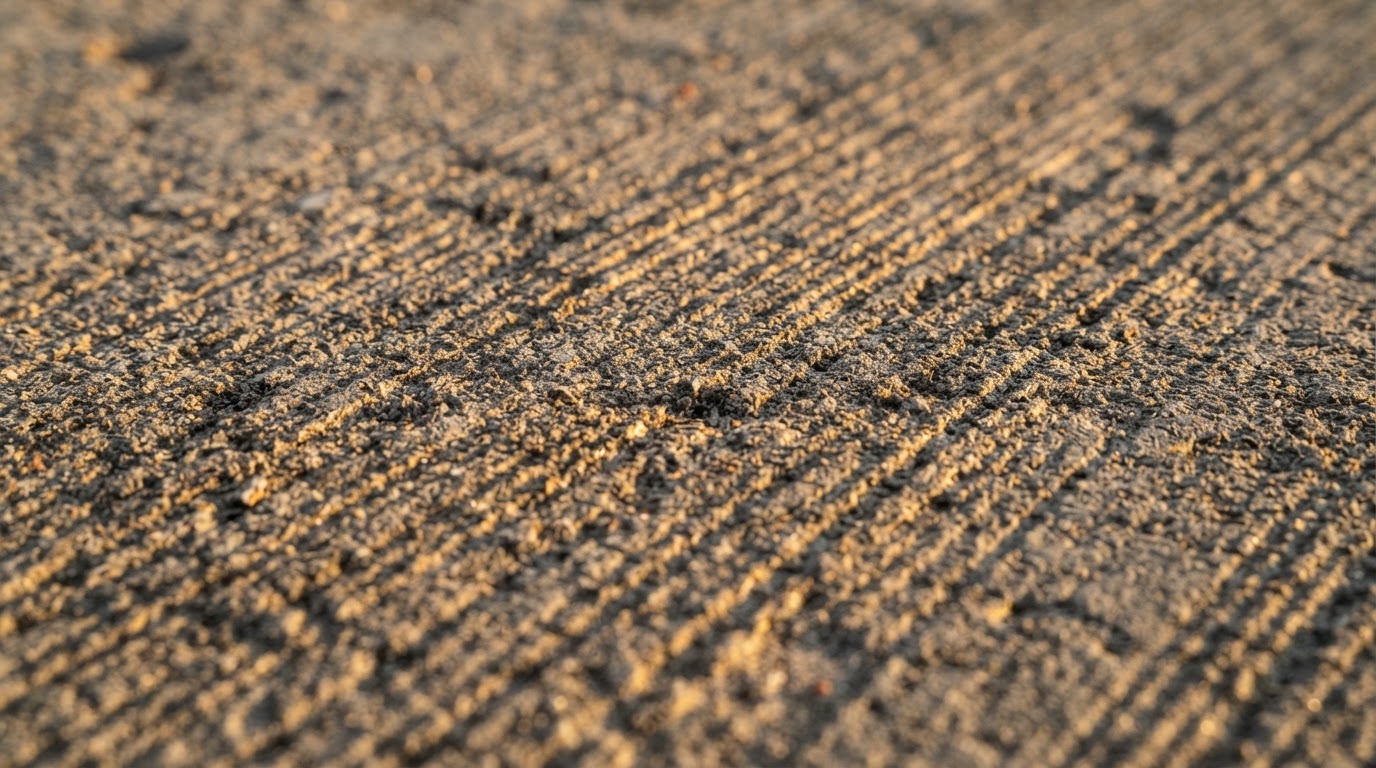
Concrete is one of the most durable things you can put on your property, and it still fails all the time. Almost every failure traces back to one of three causes — and only two of them are visible when they start.
1. Cracking
Here's the honest version: all concrete can develop hairline cracks. That's why control joints exist — they're planned weak lines that tell the concrete where to crack, invisibly, inside the joint. Hairline cracks in or near joints are normal. Cracks that are wide, growing, or offset — where one side sits higher than the other — are not. Those mean something is moving underneath.
2. Settling
A slab is only as good as the base under it. If the ground wasn't compacted properly, or if water is washing soil out from under the slab, sections start to sink. You'll notice a corner dropping, a joint turning into a step, or a gap opening under an edge. Settling doesn't heal. It progresses until the cause — almost always water — is dealt with.
3. Drainage done wrong — the one you can't see
This is the problem that causes the other two, and it's invisible on pour day. A driveway poured with too little fall, or pitched toward the house, looks exactly like a driveway poured correctly. The sun is out, the finish is clean, everyone shakes hands. Then the first real storm comes, and the water either ponds on the surface or runs back toward your foundation.
In the Fresno area this matters more than most places. Much of the Fresno–Clovis area sits on San Joaquin soil — a loam surface over a cemented hardpan two to three feet down that water can't get through. On that ground, water that lands on your lot has to leave across the surface, which means the slope of your slab is doing all the drainage work. Other neighborhoods sit on nearly pure sand and drain fast. Which one is under your driveway determines how much a slope mistake costs you.
What to do with this
If you're diagnosing an existing driveway, start with our guide to new concrete vs. resurfacing — it walks through which symptoms mean the slab can be saved. If you're planning a new pour, ask every contractor one question: before you pour, will you walk my lot and show me in writing where the water goes? That question is the whole reason our driveway process starts with a lot walk. The drainage section of our FAQ and our pricing page cover what correction involves.