
Water standing on your driveway a day after rain isn't bad luck. It's your lot telling you two things: what's underneath, and that whoever built the surface didn't plan for it. Here's what's actually going on and what your real options are.
Why Fresno lots pond
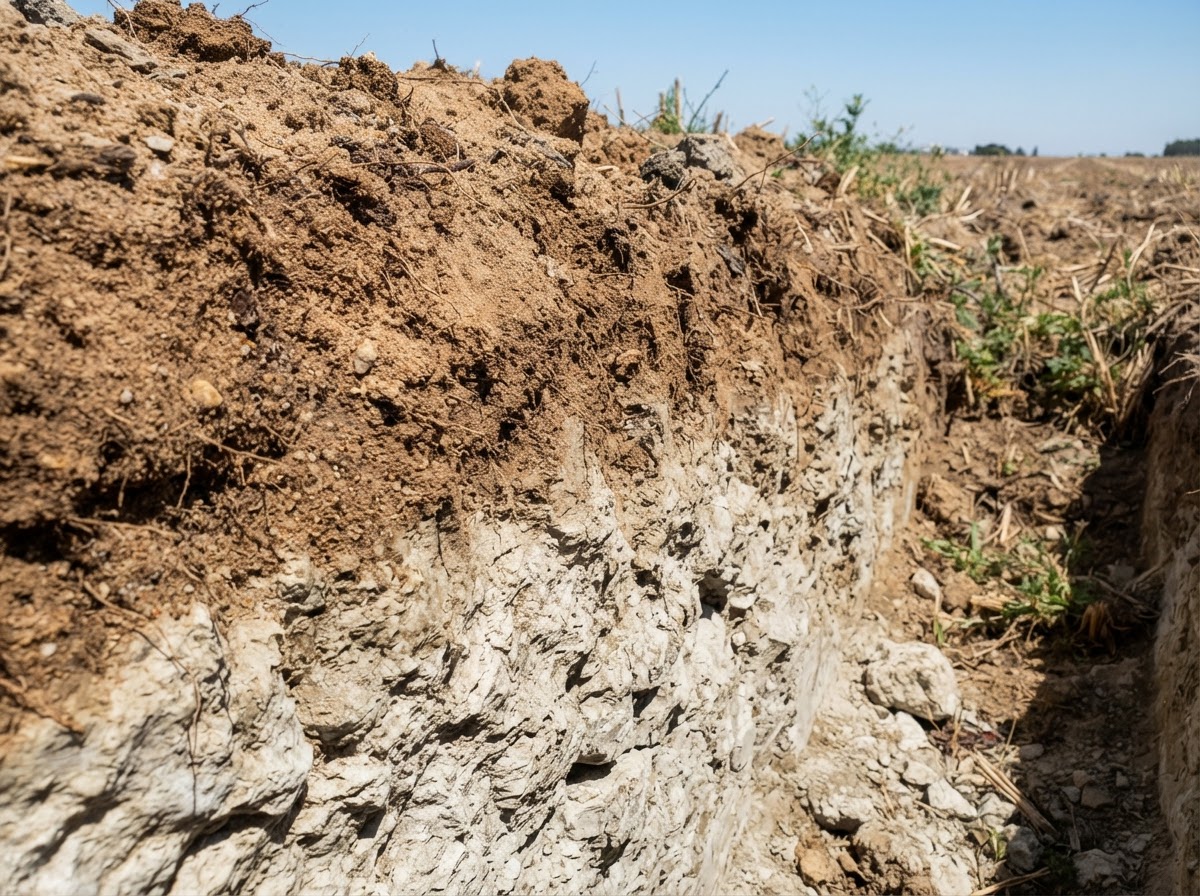
Much of the Fresno–Clovis area sits on San Joaquin soil: a loam or sandy loam surface over a cemented hardpan — a duripan — about two to three feet down. Water can't pass through that hardpan layer. USDA rates runoff on this ground medium to very high. So when rain lands on a lot like this, it doesn't soak away downward; it has to leave across the surface. If the surface has a low spot, the water finds it and stays.
Not every lot is like this — some Fresno neighborhoods sit on nearly pure sand and drain almost instantly. That lot-to-lot variation is the whole reason a driveway plan has to start with your ground, not a standard template.
What doesn't fix ponding
- Resurfacing. An overlay follows the old surface — the low spot is still low.
- Pouring a new slab at the old grade. New concrete over the old slope ponds in the same places, just newer.
- Hoping it drains eventually. On hardpan ground, "eventually" means evaporation, and meanwhile the water is working on your base and creeping toward the foundation.
What actually fixes it
Regrade and repour. The real fix in most cases: remove the affected concrete, reshape the ground so the surface falls away from the house and toward a legitimate outlet — the street, a swale, a drain — and pour to that corrected slope. This is exactly what the slope-and-drainage plan in our driveway process exists to specify in writing before the pour.
Add a collection point. Where the lot can't be resloped enough — walls, structures, a neighbor's grade in the way — a channel drain or catch basin tied to a discharge line gives the water somewhere legitimate to go. This is engineering the outlet instead of the slope, and sometimes it's the only honest option.
Consider permeable options with clear eyes. Permeable pavers get suggested for ponding lots, but on hardpan ground the water that passes through the pavers still hits the layer it can't pass through. Permeable surfaces work where the ground below can accept the water. On San Joaquin soil, they mostly relocate the pond. Our concrete vs. pavers comparison covers the broader tradeoffs.
The one question to ask
Whoever bids your driveway, ask them: where will the water go, and can I have that in writing? Grading and drainage correction is one of the honest cost drivers explained on our pricing page — and the drainage FAQ answers the follow-ups, including what we do when a lot genuinely can't be fixed with slope alone.